In
the late '30s his masterful horn soared above the finest bands.
An outstanding trumpet player of the
Swing era, he was best known for his hit recording of “I Can’t Get Started.”
One of
the first to play the trumpet equally well from top to bottom, Bunny
successfully fused the extroverted power of Louis Armstrong with the nuanced tone palette of Bix Beiderbecke.
“It was a tight little band, just a family of bad little boys, with Bunny the worst of all . . . Oh it was a mad ball.”
-- Trombonist Ray Conniff recalling the Berigan Orchestra
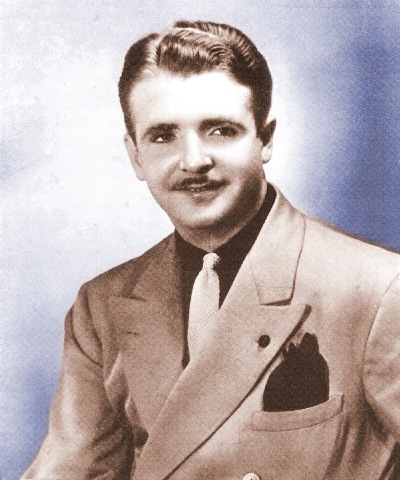
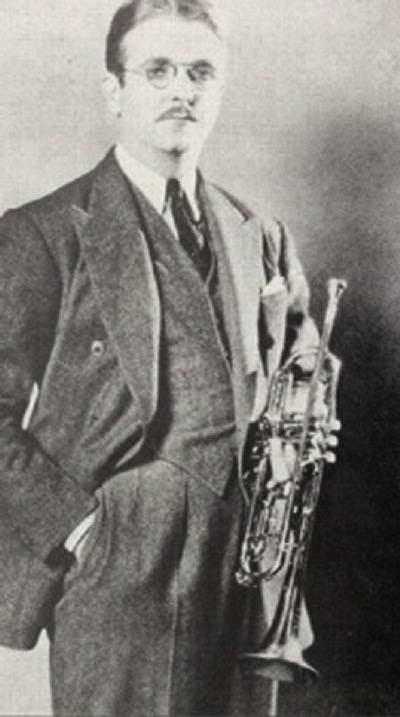
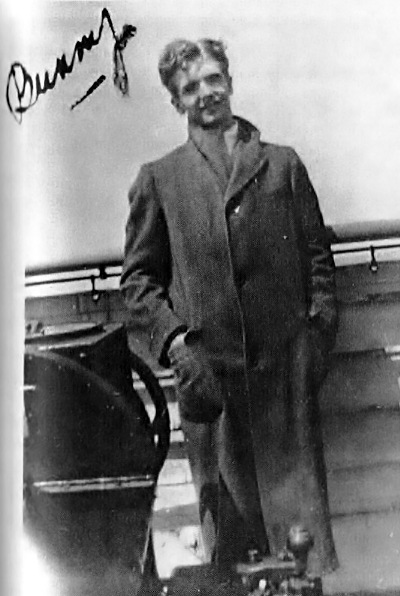
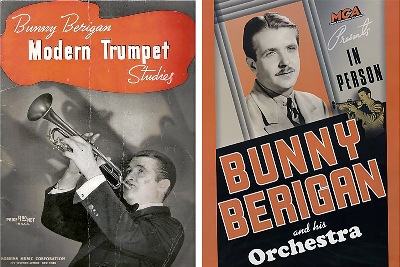
Bunny Berigan (1908-1942) was one of the first to play the horn equally well from the top to bottom of its range. He successfully fused in his personal style, the extroverted power of Louis Armstrong with the nuanced tonal palette of Bix Beiderbecke.
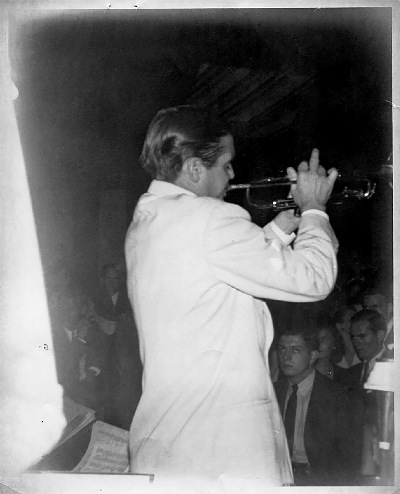
Berigan was a charming, popular and charismatic performer. By all accounts the experience of hearing his horn in live performance was electrifying. Some listeners who heard him in person have said that his trumpet sound was "life-changing." For others, there were no adequate words to describe his playing; you had to be there to experience the magic.
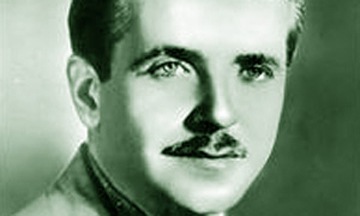
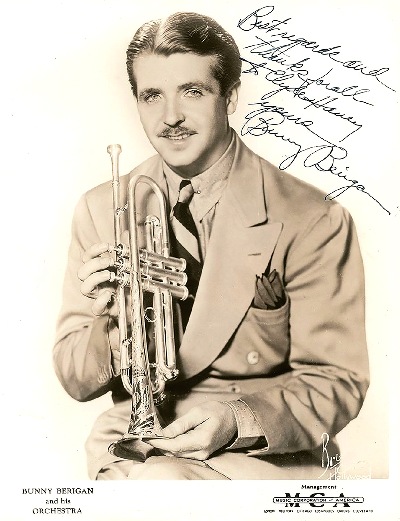
A tall handsome dark-haired Irishman, Berigan was deeply adored by his fans and admired by fellow musicians. The inspiring sound of his horn soared above the finest bands of the Swing era, gracing some of the biggest hits of Glenn Miller, Billie Holiday, Benny Goodman and Tommy Dorsey. More than 600 surviving recordings are evidence of his remarkable ability to make a tune his own and his mastery of his instrument. Sadly, despite all his talent and success Bunny Berigan died from alcohol abuse at age 33.
Starting around 1930, there was an increasing demand for Berigan's tremendous talent -- from the Dorsey brothers, the Boswell Sisters, Paul Whiteman, Artie Shaw, Red Norvo, Bing Crosby, CBS and NBC radio networks as well as the Columbia, Vocalion, Decca, Victor and Brunswick record companies.
A fine rundown of “The Prisoner’s Song” was on the flip side of his biggest hit (the 1937 extended-play version of “I Can’t Get Started”). Despite Chick Bullock’s dated singing technique, “Swing Mr. Charlie” is one of the great dance band charts of the Swing era.
It was a long hard road to fame and success for Bunny. Much of his early career was spent grinding out distracted dance music in bland hotel orchestras or steady but uninspiring residencies with less than stellar ensembles. But in 1933 Berigan began making records under his own name.
He wrote several original tunes, including the jaunty “Chicken and Waffles” recorded in 1935 by Bunny Berigan and his Blue Boys. In 1936 he won the Metronome Magazine poll among trumpeters. The subsequent 1937 recording date, A Jam Session at Victor, teamed Bunny with prestigious peers: trombonist, Tommy Dorsey; drummer George Wettling; guitarist Dick McDonough and Fats Waller. They recorded “The Blues” and Waller’s “Honeysuckle Rose.”
A STUDY IN BROWN -- Bunny Berigan Orchestra, 4/38NOTHIN' BUT THE BLUES -- Gene Gifford Orchestra 5/35 BLUES -- Bunny Bergian and his Boys, 12/35 KING PORTER STOMP -- Benny Goodman Orchestra, 7/35 SOLO HOP -- Glenn Miller and his Orchestra, 4/35 I’M COMING VIRGINIA -- Bunny Berigan and his Blue Boys, 12/35 SWING MISTER CHARLIE -- Bunny Bergian and his Boys, 2/36 I CAN’T GET STARTED -- Bunny Berigan and his Boys, 4/36 THE BUZZARD -- Bud Freeman and his Windy City Five, 4/35
THE BLUES -- Radio Broadcast Session, 3/36 SWEET SUE -- Radio Broadcast Session, 3/36 BUGLE CALL RAG -- Radio Broadcast Session, 3/36 BACK IN YOUR OWN BACKYARD -- Bunny Berigan and his Orchestra, 3/38 ROSE ROOM -- Bunny Berigan and his Orchestra, 3/38 WHISTLE WHILE YOU WORK -- Bunny Berigan and his Orchestra, 4/38 DEVIL’S HOLIDAY -- Bunny Berigan and his Orchestra, 4/38 PANAMA/I CAN’T GET STARTED -- Bunny Berigan and his Orchestra, 1939
Amalgamating Louis and Bix By the late 1920s a clear dichotomy arose in jazz trumpet and cornet style between the extroverted outlook of Louis Armstrong versus the more introverted, nuanced manner of Bix Beiderbecke. To the subtle lyricism of Beiderbecke, he welded Armstrong’s vast power, range and dynamics. In fact, his skills were often compared favorably with Satchmo, who himself declared “To me, Bunny can’t do no wrong in music.”
Berigan’s unique achievement was fusing these divergent jazz horn tendencies into his personal vocabulary. He blended the uninhibited bravura of Louis with the nuanced harmonic tonal perspective of Bix. His masterful 1935 rendition of “I’m Coming Virginia” might be the best example of this synthesis and a summary of Berigan’s best strengths.
There are odd, even spooky parallels between the careers of Bunny Berigan and cornet player Bix Beiderbecke (1903-1931). Both were from the Midwest -- Bunny from Wisconsin, Bix from Iowa next door. Each worked for a while in the Paul Whiteman Orchestra – the two even played together once on a Paul Whiteman gig, though Bix was in pretty bad shape by then. And both died at a young age from alcohol abuse.
Writing in depth about each, Richard Sudhalter points to musical similarities -- some obvious, others subtle. The use of “ghost” notes. Lengthy concentrations of eighth notes played with a bell-like attack. And melodic lines encompassing more than one contrapuntal part.
Clearly, Berigan felt a strong kinship with Bix. Six years after his death, Bunny was the first to record Beiderbecke’s original compositions. In 1938 he waxed a sensitive “Davenport Blues” and several of his obscure impressionist miniatures. The most successful musically was “Candlelights” which was arranged for a choir of six horns with a rhythm section.
CHICKEN AND WAFFLES -- Bunny Berigan and his Blue Boys, 2/36YOU TOOK ADVANTAGE OF ME -- Bunny Berigan and his Blue Boys, 2/36 THE BLUES -- A Jam Session at Victor, 3/37 HONEYSUCKLE ROSE -- A Jam Session at Victor, 3/37 SHANGHAI SHUFFLE -- Bunny Berigan and his Orchestra, 4/38 BLACK BOTTOM -- Bunny Berigan and his Orchestra, 5/38 (A SKY OF BLUE) AND SO FORTH -- Bunny Berigan and the Rhythmakers, 6/38 JELLY ROLL BLUES -- Bunny Berigan and his Orchestra, 11/38 BLUE LOU -- Bunny Berigan and his Orchestra, 1/37 MAMA, I WANT TO MAKE RHYTHM -- Bunny Berigan and his Orchestra, 9/37
CANDLELIGHTS -- Bunny Berigan and his Orchestra, 11/38DAVENPORT BLUES -- Bunny Berigan and his Orchestra, 11/38 SUGAR FOOT STOMP -- Bunny Berigan and his Orchestra, 1939 I’VE FOUND A NEW BABY -- Tommy Dorsey and his Orchestra, 8/40 I CAN’T GET STARTED -- Bunny Berigan and his Orchestra, 8/37
The Berigan Orchestra: Triumph and Disaster
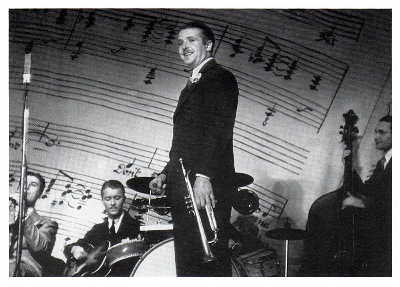
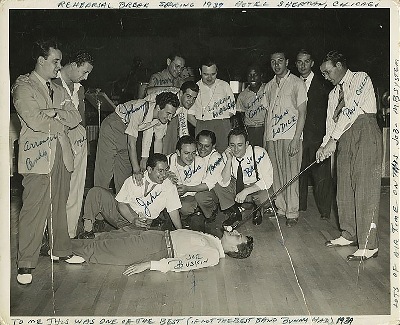
It seems that many successful Swing era stars thought they could run an orchestra. Sometimes they were urged to it by friends and fans – or by promoters and the record companies. Most failed financially even if they succeeded musically. Bunny was no exception and made several attempts at leading a band. Berigan’s orchestra at its best had a driving energy and danceability equal to the big-name outfits, thanks in part to a series of very good drummers like George Wettling, Dave Tough and Buddy Rich. Unfortunately, the performance format that succeeded for him was very taxing. requiring Berigan to simultaneously play trumpet and direct the band on nearly every number.
Notably, in launching the enterprise Berigan received considerable assistance and support from his longtime friend and mentor, trombone player and bandleader Tommy Dorsey (1905-1956). Dorsey was a superb jazz musician -- despite becoming one of the most bankable names of Swing and Big Band music. In an extraordinary gesture of devotion, he chose to assist Berigan’s orchestra for a season, working as a sideman and manager.
Bunny’s outfit contained several excellent and then-notable soloists. Among the best was Georgie Auld (1919-1990), a Canadian-born Coleman Hawkins-inspired tenor saxophonist. He imparted a bright tone and lightness to many of the Berigan records, before moving on to join Artie Shaw and then Benny Goodman. Much later, Auld appeared in and was heard prominently on the soundtrack of the 1977 motion picture “New York, New York.”
Clarinet player Joe Dixon enthused that the ensemble had “sizzle, real élan” and was “the best band in the country at that time.” Band pianist and arranger Lipman felt the orchestra got a “lotta love,” saying that everybody wanted to play with them. But Dixon said that Bunny’s leadership role “made him uncomfortable, isolated from the men.” Drummer Johnny Blowers found his management, “lackadaisical . . . not disciplined.”
A fine trombone player named Ray Conniff was in Berigan’s orchestra and recording sessions of 1938-39. The talented arranger, who produced Pop hits in the 1950s and ‘60s, may well have contributed to the formidable Berigan book. Conniff recalled: “It was a tight little band, just a family of bad little boys, with Bunny the worst of all. We were all friends . . . Oh it was a mad ball. You should have seen those hotel rooms! Ribs, booze and women all over the place.” Berigan was bankrupt within three years.
Berigan’s most productive year in the studio was 1938. About a dozen sessions generated numerous masterworks. Five of Bix Beiderbecke’s tunes were memorialized – including one of the best, “In a Mist,” which was also one of Berigan’s best records.
A leisurely interpretation of “Jelly Roll Blues” brilliantly reworks Morton’s gem that had lain fallow for a decade; Sudhalter finds in Berigan’s interpretation unexpected emotional depths and a mood of “lamentation.”
Whether drunk or sober, Berigan was an incomparable musician. “Even when he was drunk, he’d blow good,” Ray Conniff attested. But drinking made him unreliable and undermined the confidence of his employees, employers and peers. After dissolving the orchestra in 1940 Bunny worked for other name bands, mostly Tommy Dorsey.
As his alcoholism progressed there were “incidents” of Bunny passing out onstage or falling off the bandstand. By the early 1940s, he was physically wasted and suffering all the horrors of late stage alcoholism: cirrhosis of the liver, edema, tremors, delirium. His dear friend Tommy Dorsey was with him when he died in June 1942. Berigan was 33 years old.
Fans and fellow musicians were struck by some magic, a special charisma that Berigan conveyed in live performance. Benny Goodman said his presence sent, “a bolt of electricity running through the whole band . . . he just lifted the whole thing.” Jazz writer Richard Sudhalter points to his “innate grandeur of conception, lending a sense of inevitability to whatever he plays.” Berigan’s music was not calculated primarily to impress, but to serve the musical narrative. True, he was eager to please his listeners and not above using novel effects to achieve his ends through growls, ragged tones, staccato notes, mutes, cups or even hats. Yet each phrase, note or variation in his 600 surviving recordings tends to focus attention on the music rather than the performer.
Squaring the circle of early jazz horn, he brilliantly merged the reflective sensitivity of Bix Beiderbecke and the extroverted power of Louis Armstrong. For a decade of the Swing era, Berigan was one of the most consistently expressive and inspiring talents of his generation. Three quarters of a century after the premature passing of Roland Bernard “Bunny” Berigan, the soaring spirit of his trumpet endures.










































































































































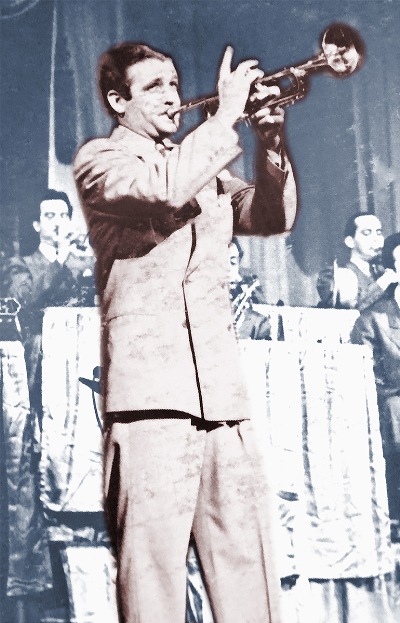
 The Berigan Orchestra: