Now that its been a century since the birth of William “Count” Basie, its clear how crucial he was in bringing Swing music to full fruition. Basie and the musicians who coalesced around him brimmed with talent, innovation & genius.
The best Basie orchestra tunes like “One O’clock Jump,” “Jumpin at the Woodside” and “Swinging the Blues” are based on simple riffs tossed between the reeds and brass, carried along by a buoyant rhythm section. The Basie rhythm was superbly streamlined and subtle -- yet delivered terrific forward momentum and punch on the bandstand night after night.
Recordings from 1937-40 like, “Taxi War Dance,” “Every Tub,” or “Doggin Around” illustrate the Basie orchestra’s forward looking aesthetic & technique: * streamlined 4-beats to the measure swing; * loose head arrangements based on simple riffs; * call-and-response patterns between the brass and reed sections, soloists and ensemble; * inspired solo improvisation, especially Lester Young’s revolutionary tenor saxophone; * incomparable dynamic energy and rhythmic drive.
A Tribute to Count Basie and his Orchestra
COUNT_BASIE_1A.mp3 PAGIN’ THE DEVIL -- Kansas City Six 1938 ROSELAND SHUFFLE -- Count Basie and his Orchestra, Live at The Famous Door, 1939 JOHN’S IDEA -- Count Basie and his Orchestra, 1937 TEXAS SHUFFLE -- Count Basie and his Orchestra, 1938 TAKE IT PREZ -- Count Basie and his Orchestra, Live at Southland Theater Restaurant, 1940 JUMPIN’ AT THE WOODSIDE -- Count Basie and his Orchestra,1938 ONE O’CLOCK JUMP -- Count Basie and his Orchestra, Private Acetate, Glendale 1939 COUNT_BASIE_1B.mp3 PAGIN’ THE DEVIL -- Kansas City Six 1938 ROSELAND SHUFFLE -- Count Basie and his Orchestra, live 1939 JOHN’S IDEA -- Count Basie and his Orchestra, 1937 TEXAS SHUFFLE -- Count Basie and his Orchestra, 1938 TAKE IT PRES -- Live at Southland Theater Restaurant, 1940 JUMPIN’ AT THE WOODSIDE -- Count Basie and his Orchestra, 1938 ONE O’CLOCK JUMP -- Count Basie and his Orchestra, Private Acetate, Glendale 1939
COUNT_BASIE_2A.mp3 BILL'S MILL -- Count Basie and his Orchestra, 1947 TIME OUT -- Count Basie and his Orchestra, Live at The Famous Door, 1939 MOTEN SWING -- Benny Moten’s Kansas City Orch, 1932 BLUE ROOM -- Benny Moten’s Kansas City Orch, 1932 DING DONG BLUES -- The Dreamland Syncopators, Keith Nichols & Klaus Jacobi, 1987 BLUE DEVIL BLUES -- Walter Page’s Blue Devils, 1929 THERE’S A SQUABBLIN’ -- Walter Page’s Blue Devils, 1929 SWINGIN' AT THE DAISY CHAIN -- Count Basie and his Orchestra, 1937
COUNT_BASIE_2B.mp3 BLUE LESTER -- Lester Young Quartet, 1944 JUMP LESTER JUMP -- Lester Young Quartet, 1944 LADY BE GOOD -- Count Basie and his Orchestra, broadcast from Glendale, 1939 POUND CAKE -- Count Basie and his Orchestra, broadcast from Glendale, 1939 SWINGIN’ THE BLUES -- Count Basie and his Orchestra, 1947 BACKSTAGE AT STUFF'S -- Count Basie and his Orchestra, 1947 JUMPIN’ AT THE WOODSIDE -- Count Basie & Oscar Peterson, pianos, 1974
COUNT_BASIE_3A.mp3 BUGLE BLUES -- Count Basie and his All American Rhythm Section, 1942 HOW LONG BLUES -- Count Basie & his All American Rhythm Section, 1942 CAFE SOCIETY BLUES -- Count Basie & his All American Rhythm Section, 1942 BASIE BOOGIE -- Count Basie and his Orchestra, 1944 GOIN’ TO CHICAGO BLUES -- Basie’s Bad Boys, vocal Jimmy Rushing, 1939 BABY DON’T TELL ON ME -- Jimmy Rushing, vocal, Live Southland Theater, 1940 DON’T WORRY ABOUT ME -- Count Basie and his Orchestra, Helen Humes vocal Live, 1939 YOUR RED WAGON -- Jimmy Rushing vocal, 1947 DO YOU WANNA JUMP CHILDREN -- Jimmy Rushing vocal, c. 1938
COUNT_BASIE_3B.mp3 THE DIRTY DOZEN -- [Basie and Rhythm], 1938 SWING, BROTHER SWING -- Count Basie and his Orchestra, Billie Holiday vocal Live, 1937 I CANT GET STARTED -- Count Basie and his Orchestra, Billie Holiday vocal, Live 1937 ME, MYSELF AND I -- Billie Holiday and her Orchestra, 1937 SENT FOR YOUR YESTERDAY -- Count Basie and his Orchestra, Jimmy Rushing, 1957 EVERY DAY I HAVE THE BLUES -- Count Basie and his Orchestra, Joe Williams, vocal, 1958 DICKIE’S DREAM -- Count Basie’s Kansas City Seven, 1939 SEVENTH AVENUE EXPRESS -- Count Basie and his Orchestra, 1947
COUNT_BASIE_4A.mp3 BOOGIE WOOGIE BLUES -- Count Basie and his Orchestra, live vocal Jimmy Rushing, 1939 BOOGIE WOOGIE -- [Basie and Rhythm], 1938 HOUSE RENT BOOGIE -- Count Basie and his Orchestra, 1947 RED BANK BOOGIE -- Count Basie and his Orchestra, 1961 BYE BYE BABY -- Count Basie and his Orchestra, vocal Jimmy Rushing, 1947 NOW WILL YOU BE GOOD? -- Count Basie and his Orchestra, vocal J. Rushing, 1938 GETTING SOME FUN OUT OF LIFE -- Billie Holiday & her Orchestra, 1937 TRAVELING ALL ALONE -- Billie Holiday and her Orchestra, 1937
COUNT_BASIE_4B.mp3 APRIL IN PARIS -- Count Basie and his Orchestra, 1955 ROSES OF PICARDY -- Count Basie and his Orchestra, vocal Jimmy Rushing, Glendale, 1939 BRAND NEW WAGON -- Count Basie and his Orchestra, vocal Jimmy Rushing, 1947 DON’T CRY BABY -- Count Basie and his Orchestra, vocal Jimmy Rushing, 1944 ROCK-A-BYE BASIE -- Count Basie and his Orchestra, 1944 9:20 SPECIAL -- Count Basie and his Orchestra, 1944 ONE O’CLOCK BOOGIE -- Count Basie and his Orchestra, 1947 I AIN’T GOT NOBODY -- Basie’s Bad Boys, 1939 I’VE FOUND A NEW BABY -- Count Basie and his Orchestra, 1944
Lester Leaps In
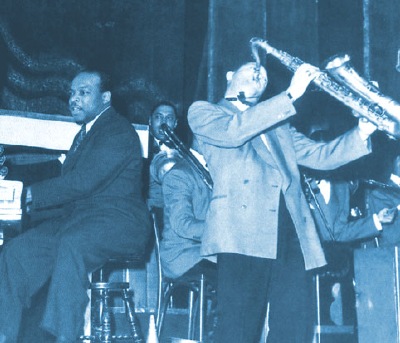
Tenor saxophonist Lester Young was the brightest star and resident genius of the Basie organization. In the late-1930s he radically changed saxophone style with a highly original approach that defied the existing rules of jazz instrumentals. Young abandoned the predominant Coleman Hawkins tenor saxophone sound of rich overtones and deep vibrato and improvisation on harmony.
Instead Lester focused on melody, while streamlining and stripping it down, simplifying and abbreviating tunes as he explored harmony and melody. The tone of his instrument was lighter, and Young exploited 4-beat rhythms to generating a more dance oriented rhythmic signature.
Lester Young is always doing the unexpected. His choices of line and phrase, melodic intervals and accents continually surprises. With Lester the notes he chooses NOT to play are as significant as the notes he DOES play.
The famous “Lester Leaps In” with the 1939 Kansas City Seven, a small unit of the Basie band, demonstrates his economic and unexpected choice of notes; odd harmonic intervals; light, almost brass-like sax tone; and simplification of the melody line, itself an abbreviation of “I Got Rhythm.”
Supporting Lester, the soloists and orchestra, was the Basie rhythm section: THE finest of the swing era. Drummer Jo Jones was just as spare and economical with his drums and brushes as Basie was on piano.
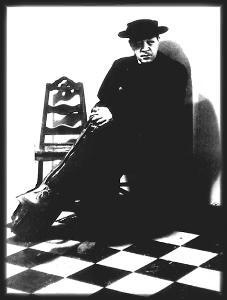
Bass player Walter Page was crucial in shaping Kansas City swing. He developed key rhythmic innovations in precursor bands. He was a masterful veteran of the seminal Benny Moten Orchestra, and his own legendary Blue Devils.
Called “Big Un” Page served as a mentor and behind the scenes architect of the radically new Basie rhythm section. His unique approach retained the spontaneity of small band jazz within a larger ensemble.
One of his key insights was restraint: Page instructed the rhythm section to bring the VOLUME down, but keep the INTENSITY up. This offered dynamic range and created space for the blending of timbres -- resulting in the rhythm section sounding seamless, almost like one instrument, leaving more room for the band’s remarkable soloists.
Page also encouraged continually shifting the rhythm in order to counterpoint and support the horns and soloists. Contrasts in the rhythm patterns emphasized the various transitions and shifting colors of the front line horns, creating a supportive and highly flexible undercarriage for the band’s powerhouse brass and reed sections.
Investigating the finest rhythm section of the Swing era.
Don't Forget the Vocalists
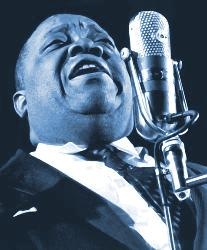
The Basie innovations extended to the vocalists as well. Jimmy Rushing succeeded at adapting blues to a modern swing band better than just about anyone else. He had a surprisingly light and youngish sounding voice for such a large man, nicknamed “Mr. Five-by-Five.”
Billie Holiday sang with the Basie orchestra; but she wasn’t a blues singer. Yes, she could bend a blue note and was influenced by the blues, but Holiday was primarily a jazz singer. (She used her voice interpretively the way a jazz instrumentalist did. In early years her song material was mostly ballads & pop songs with very little actual blues content.)
During her year with Count Basie 1937-38, Billie became very close with the band members, developing a remarkable musical relationship with Lester Young and apparently a love relationship with trumpet player Buck Clayton. Sadly, she couldn’t record with Basie because of her contract with a competing record label, though a few air checks have been issued over the years.
Fortunately Holiday drew heavily from the Basie personnel for her own recordings. In those sessions -- nominally under the musical direction of pianist Teddy Wilson -- we hear the continuation of her intimate dialog with the Basie-ites: Lester Young, Buck Clayton and the remarkable Basie rhythm players, Jo Jones (drums) and Freddie Green (guitar).
Holiday’s best sessions of the late 1940s feature Lester deftly backing and supporting her vocal line, creating a pleasing counter-melody; Buck Clayton’s muted trumpet ‘fills’ -- sensitively placed between her breaths and pauses; and a smooth blending of instruments in a relaxed atmosphere of fellowship.
Bill Basie: the Kid from Red Bank
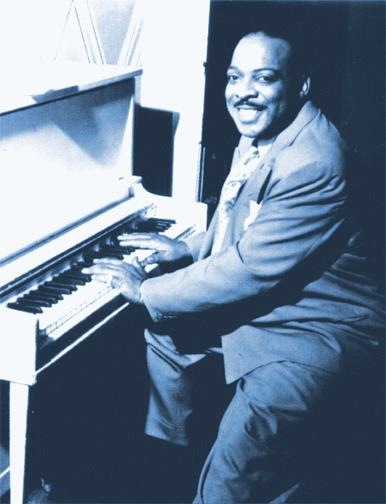
Count Basie, himself was not from the Midwest but hailed originally from Red Bank, New Jersey. Basie’s mother was his first piano teacher, which might have influenced the nurturing way he directed his musicians from the keyboard. He clearly learned well from the two masters he had received instruction from, James P. Johnson and Fats Waller.
Basie was stranded in Kansas City when a band he was touring with went bust. He stayed for the thriving nightlife that was generating work for entertainers. Kansas City, Missouri during prohibition and in the early years of the Great Depression was a wide-open “sin city” under the benign dictatorship of gangster and political boss, Tom Pendergast.
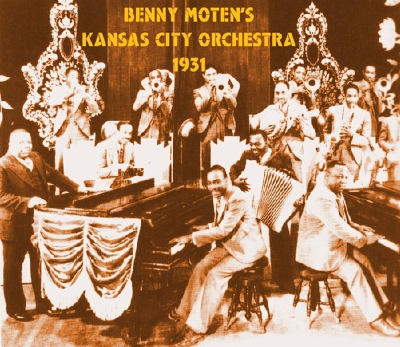
In Kansas City Basie hooked up with the best connected musical outfit; Bennie Moten’s Kansas City Orchestra. Moten was a fair pianist, composer and musical director with connections to the Pendergast political machine that generated work for his band. Moten built a large aggregation of formidable musical talent, including tenor sax giant Ben Webster; trumpeter Hot Lips Page; trombonist, guitarist and arranger Eddie Durham; singer Jimmy Rushing, and bassist Walter Page.
As he fused the best elements of stride, blues, boogie and jazz piano into a personal voice Basie trimmed off anything that impeded rhythmic momentum; always simplifying his instrumental vocabulary. Like Lester Young he was deliberately abstracting and abbreviating, surprising the ear equally with both the notes he played, and the notes he chose NOT to play.
Basie developed a highly personal style of his own that was subtle and spare: based on understatement. On his small-band discs he was brilliantly supported by his famed rhythm section.
In the 1930s and ‘40s Basie’s onstage persona and public image was suave and handsome. Later as an elder statesmen of jazz, he was cherubic and gnome-like.
During the 1950s and ‘60s Basie reinvented his band, utilizing some of the best arrangers around: Quincy Jones, Neal Hefti, Benny Carter, and Thad Jones. He hired top flight soloists like Eddie “Lockjaw” Davis, drummer Buddy Rich, Clark Terry and Buddy de Franco, and recorded with popular stars like Ella Fitzgerald, Tony Bennett and Frank Sinatra.
Basie’s orchestra toured the United States, Europe and Japan, and he became an evergreen: down to earth; true to jazz and blues. William “Count” Basie was deeply loved and respected by his fans musicians until his passing in 1984.










































































































































 Lester Leaps In